Thoroughly applaud Guernsey’s plan to make itself the catchphrase and mannerism IP litigation capital of the world.
Being almost a household name myself (blog readership figures now exceed total number of blog entries, even allowing for Russian bot-generated statistics) I’ve done an audit to identify any marketable tics and trademark utterances of my own.
Research consisted of asking my 17-year-old son, who is convinced that I am a truly unique individual in many ways. We finally ended up with this list:
• Unique expression of confusion when attempting any complicated manual task.
• Unique combination of profanities and expletives following the above (for decency’s sake, the exact wording will be entered in a separate appendix, named Catchphrase A).
• Unique expression directed at 17-year-old son intended to defer blame for manual-task-related mishap from self to said 17-year-old-son.
• Unique fashion style as worn on high street, restaurants, tennis court, etc, a fusion of styles from every decade going back to the early 70s and featuring significant amounts of perished elastic.
• Unique combination of profanities and expletives directed at other users of the roundabout closest to our home (as above, separate appendix B).
He had more, but they were, with due respect, less than respectful.
This fledgling personal-brand IP scheme, does, of course, rely on other people being familiar with and copying one’s own mannerisms. The first issue, familiarity, is, according to my son, not a problem, apparently my mannerisms are universally known. As for the second, he is adamant that only a stunned octopus would knowingly attempt any such mimicking behaviour and then only in the safety of its cave.
But that could just be adolescent cheek.
Friday, 29 June 2012

Monday, 25 June 2012
Italy's typeface: why they won't win the European Cup
Clearly a superior
side, why did Italy need to go to penalties to beat a tired-looking England
team? Why didn’t the pundits take them seriously before the game? And why won’t
they win the competition?
Simple. A typeface. I
mean, just look at the picture below:

Typeface translation: "Enough with the aggression already, let's hug."
What the name on the back of your shirt should be saying is: ‘I am almighty. Deal with it.’
Instead, Italy’s
typeface is saying: ‘Er, excuse me, but don’t you think the groundsmen have
done a lovely job of cutting nice broad stripes into the grass? Oh, you’d like
the ball?’
(And when your players are called stuff like 'Donucci' it really is important to put some kind of aggressive spin on them.)
So instead of running
around feeling intimidated like they usually do in quarterfinals, the England
team actually made a really brave attempt to not lose. Which crumbled when they
got to the final penalty shootout, where shirt backs don’t really come into
play.
Now can you imagine
how seriously the Germans are going to take that typeface? Bar an emergency font rethink, it’s all over for Italy.
Monday, 4 June 2012
Sun comes out for virtual diamond jubilee street party
My virtual street party concept for a social media pitch earlier this year (with art director Pete Vincent), sadly unsold:

Thursday, 31 May 2012
IKEA's interesting approach to customer service
Was spending some time in the Customer Services area of my local IKEA when I noticed the sign below:
 |
| IKEA bits buckets, a great customer service idea – or is it? |
Genius, I thought, instead of having grumpy customers clogging up the queues just to ask for an extra IC3XB7 washer to replace the one that rolled under the fridge, they can just go and pick one up from one of these buckets.
Full marks for IKEA for thinking of the idea and for trusting their customers not to abuse the system.
So I took a closer look (it was a long wait I was having) and noticed that only two of the fifty buckets had anything in them.
Friday, 25 May 2012
The copywriter recruitment ad I'd write for myelf
Am I the only copywriter
who’s tired of being patronised with recruitment ads promising ‘your big break
at a multi-award winning agency’?
We all know that that
kind of agency doesn’t need to actively recruit creatives. They have bouncers
at the doors instead.
More realistic recruitment
copy in today's adland reads something like this:
“Given a brief with
more propositions than David Beckham on an away weekend, you’ll either come up with a better proposition yourself or, if the client absolutely refuses to budge, cram the
conceptual camel through the eye of the needle anyway.
“If the art director
has to take time out to do a shoot or gets struck down with norovirus, you
won’t twiddle your thumbs until she gets back but just get scamping regardless. And in
fact, some of your best ideas have come from working with planners, designers
and other copywriters.
“You don't mind working late occasionally. But you’ve found that if
you keep the accelerator all the way down during regular working hours, everyone gets to go
home on time.
“You have a great
track record on pitches, mainly because you savage the strategy on Day One
rather than wait for someone else do it at the final creative review on Sunday
evening.
“When a drunken
research group throws an idea back in your face, you can separate the baby from
the bathwater and make it smile even more cutely.
“You’ll fight tooth
and nail for award-winning results and to lift the agency’s creative
reputation. You’ll also fight for a lump of brown mud if you think it’s a
harder-hitting piece of communication.”
If that’s a
recruitment ad that’s relevant to your agency, please consider me to have
applied.
Monday, 14 May 2012
Premier League final Sunday: a resounding script success
After an agony of
strict confidentiality, I can now reveal that the events of the Barclays Premier
League’s final Sunday were orchestrated and scripted by none other than myself
after a gruelling strategic and creative process.
Initially dismissed by
Sir Alex Ferguson and others as “wildly unbelievable”, my script was finally
accepted with hardly any amendments by the disparate collection of stakeholders,
and the plan flawlessly executed on the day. Here are the details:
Clients: The FA, Barclays
Premier League and Sky
Target market: Jaded
football viewers and football agnostics
Brief: Revitalise the
Premier League brand both locally and internationally. Convert ‘Match of the
Day’ viewers to Sky Sports subscriptions. Retain wavering Sky Sports subscribers.
Proposition: “Insane
levels of excitement until the very last whistle”
A daunting brief, and
without the total support of everyone involved, the final outcome would have
been impossible. A special thank you to Joey Barton for playing the villain with
such genuine commitment (the sacrifice was worth it).
Re Mr Mancini's extraordinary performance: at times the over-the-top histrionics risked believability but
ultimately contributed to the humour of the occasion – in retrospect essential
to relieve the unsustainable levels of tension.
See a final curtain call here:
Friday, 4 May 2012
Argentinian Falklands 2012 Olympics ad – creative fail
In the
semi-dark, a man furtively creeps out onto the Falklands streets. Guiltily
pulling up his hoodie, he goes for a jog, then hammily collapses into some
sand.
“To compete on
British soil, we train on Argentine soil,” read the titles.
As a jingoist
rallying call to the Argentinians, the ad works fine. But when you consider
that it was inevitable that the ad would go viral in the UK as well, it's an
own goal*.
Even though
I’ve never felt passionate about the Falklands, this ad polarised me instantly:
against Argentina. Lord Kitchener couldn’t have come up with something more
effective.
Yet the ad
could have made its point while also communicating that Argentinians have a
sense of humour. Why’s that important? Because I'm sure that British people
would find it a lot harder to support a war against people who they think have
a similar sense of humour to themselves.
To rally the
Argentinians, while keeping British fence-sitters firmly (if slightly
uncomfortably) on the fence, all the ad needed was a smarter endline: “This
August, we’ll lay claim to all their islands.”
Provocative,
but with just enough wit to make their point without being crassly warlike.
*Of course, the
fact that the best athlete they could find to represent Argentina's
medal-winning aspirations was a hockey player doesn't really augur well, but
creatively that's splitting hairs.
Wednesday, 2 May 2012
For a better B2B copywriter, try one who’s owned one
Writing B2C copy isn’t
too difficult. After all, we’re all consumers. So we can always sense-check our
copy by asking ourselves whether we’d find it relevant and compelling if we
were to come across it on the web or on our mat.
But most B2B
copywriters have never owned a business. So they have no way of checking whether
their copy is convincing enough to make a business owner risk even one pound of their company’s
money.
That’s why most B2B
copywriters tend to write in a fairly simplistic and patronising way. “For a
better bottom line, call now” is a typical example of the genre.
Anyone who’s ever run
a business knows that there are always a hundred different opportunities,
demands and problems clamouring for their attention at any moment. The idea
that a particular product or service is going to magically improve their cash
flow with no further investments in terms of time, training or reorganisation
is usually a fantasy.
· New, cheaper internet? Fine, but would I risk
my business’s connectivity even for one hour?
· Cheaper business insurance? Great, but how long
would I have to wait for my payout?
· Cloud computing? Brilliant, but again, 100%
data availability is far more important than getting rid of my server.
I became a B2B
copywriter only after running my own business. So I know what it’s like to
negotiate the tightest possible deals, to eke out your cashflow, to get a lifeline
from a bank, to grow customer relationships phonecall by phonecall, to fight competitors
tooth and nail, and to celebrate a major sale.
To see what I mean, read one of my B2B samples here.
Tuesday, 1 May 2012
Flerm behaviour: the new brand planning paradigm
Precarious stacks of
dog-eared psychology and sociology textbooks clogged the only office window,
blocking the light and my view of the Yale quadrangle. In the gloom, a
desk-hogging assemblage of old and new monitors showed constantly changing
word- and image-clouds: the ever-updating zeitgeist as intermediated by
Pinterest, Twitter and Facebook.
Professor Gluebender finally
got a match alight, lent back in his duct-taped chair and puffed smoke at the
stained ceiling.
I hoped my jetlag
wasn’t obvious as I asked him about his research: research which looks set to
overturn current advertising thought.
“Ah yes, well, you
see, advertising planner and strategists have always tried to model the human
consumer to an easily understandable, pattern-following animal. A flock animal,
that follows a leader, for instance.”
“So you create your
advertising for that leader?”
“Exactly.” Puff. “Of
course it always turns out that leaders are only leaders when they champion
products and causes that their flock likes. Soon as they get it wrong, their
flock deserts them for someone else. So. Begs the question. If the flock has
already made up its mind, how did it do so?”
“Hence the pack
model?”
“Ah yes, the pack
model. Where every creature in the pack is constantly working to maintain or
improve its position in the pack through its likes, dislikes and
alliances. Its brand preferences,
if you will.”
“And how did that go?”
“Well, humans tend to
jump from pack to pack according to likes and dislikes, so the pack model
didn’t go too well either, of course.”
“I’ve read of the herd
model?”
“Ah.” Cough. “The herd
model. Turned out the only herd-like behaviour to be found in the human world
was amongst advertising planners.”
“What came next?”
“The swarm, of course.
With just six rules or fewer, an infinite number of creatures can co-exist in
harmony… so advertising becomes simply a matter of pressing a very few buttons
in the right way.”
“And?”
“Still works for hair
care products. That’s about it, though.”
“But now you’re onto
something new?”
“Ahem. I like to think
so. Indeed. My model assumes that you have early adopters, followers, deviants,
authorities, evangelists, dependents, influencers, critics, laggards,
bewilderds, confuseds, and the just plain uninterested.”
“Mmhm?”
“And then of course,
they all switch roles at random intervals for no particular reason.”
“And you call your
model...?”
“Flerm behaviour. For
now, anyway.”
It was a long ride
back to the airport.
Saturday, 28 April 2012
MI6 spy-in-a-bag: 2-4-1 offer
Want to infiltrate a foreign power? Hack the Culture Secretary’s phone calls? Or just want to know what the hell’s going on?
For a limited period
only, we bring you this fabulous offer of an MI6 spy – highly trained in the
latest surveillance, cryptography and bondage technology – conveniently sealed
into a take-anywhere, release-anywhere sports bag.
Surveillance skills
include the ability to film their own buttocks! Cryptography skills are so
advanced, even colleagues and police experts are powerless to discern or
decipher them! And their MI6 bondage skills are simply too embarrassing to go
into in any detail here.
Order now and – due to
departmental staff cuts – we’ll send you not one but two spy-in-a-bags! Don’t delay, air supplies are running out fast!
Disclaimer: Should
your spy-in-a-bags not be fully alive on delivery, please leave them out with the
garbage, carefully separating organic from non-organic material and placing in
the correct wheelie bins. Do not attempt to boil.
Tuesday, 24 April 2012
Getting the most from a freelance copywriter: a guide for the smaller ad or design agency
In my own experience,
the majority of agency-copywriter relationships work professionally, productively
and fruitfully for both parties. However, if you’ve ever had difficulty getting
what you want from a freelance copywriter, this guide may show where you’ve
gone wrong – and how to make it work properly next time around.
You’ve found a freelance
copywriter via LinkedIn, Google or word of mouth, and now you’d like to get
their unique magic working for you and your clients. Here’s how to start, and
maintain, a mutually happy relationship.
1.
Call up
the copywriter, introduce yourself and explain why you’ve chosen him, perhaps
referring to his agency or client experience or a particular piece of work that
you like. Explain how he’ll be a good fit for your agency and client base.
Invite him in for a short try-out gig and agree a mutually satisfactory daily
rate.
2.
When the
copywriter arrives at your agency, make him feel at home by leaving him in
reception for some time to orientate himself. This way, he can get a feel for the agency without any
pressure. He can look around, see what kind of décor and publications the
agency values and learn how your water cooler or coffee machine works.
3.
Welcome
the copywriter with enthusiasm, go to a meeting room and take him through the
brief. Chances are he’s brought his own writing pad and pens with him – the kind
he’s most comfortable working with - and won't need access to your stationery cupboard. He will hopefully also have brought his own
laptop, in which case, great, it saves a lot of IT bother on your end – and on
his side, he won’t have to fiddle around creating a new account and so on.
He’ll probably need access to your WiFi though – someone can sort that out for
him later.
4.
Once
you’ve gone through the brief and dealt with the copywriter’s suggestions about adding a proposition to the brief, make sure he has enough workspace to get on with the job.
Giving him his own desk is obviously ideal, but you can also put him between
two of your staff, so each ends up with two-thirds of a desk, which is almost
as good as each having a whole desk.
5.
Something
to consider: until the copywriter gets used to your work environment, he will
probably find your office chit-chat a bit distracting. So it’s a good idea to
position him as close as possible to your server: the ‘white noise’ will help
him stay focused. And if it’s the middle of winter, the heat will be welcomed.
6.
Having his
own laptop, the copywriter will obviously not be able to access your network
printer. This is another mutually beneficial thing. Because rather than print
out his own copy to check over and craft, he’ll have to email it to you to
print out. You can then see exactly how he’s doing, forward the copy to
colleagues and your line manager, collate comments and come straight back to
him with your own headline suggestions and copy tweaks – all before lunch.
7.
By the end
of the day, you’ll probably find that your copywriter is fine with email
conversations about copy tweaks and new briefs, rather than bothering with face-to-face
communication. This means that he won’t even need to work in-house, a huge
advantage for both of you. You can negotiate an hourly rate, meaning that you
won’t have to pay for any downtime caused by delays and meetings on your end –
and he doesn’t have the bother of a commute.
8.
It’s
commonly known that freelancers are typically quite flush and will thus happily
help to buffer your agency’s cashflow. The copywriter will obviously bill you
as and when he completes your projects, but you will only need to pay him when
he actually requests payment (and even this is open to some flexibility). The
first payment request is likely to be at 30 days, but obviously, every extra
day is a plus for your agency finances. It is never wise to pay your copywriter
too quickly, as once he is no longer owed money by your agency he has less
incentive to drop everything for the next brief you send through.
9.
As your
copywriter becomes more familiar with your clients, you will find that you can
spend less time developing and refining your copy briefs. By simply sending
pdfs of reference material and urls of related websites, you can brief him
perfectly adequately and create more valuable time for your real work.
10.
As time
goes by, you will inevitably find that your copywriter’s eagerness to put his
other clients aside for your briefs will wane to some extent. It is then
imperative that you rekindle the spark. An ideal way to do this is to
remotivate him with a pitch project. Not a pitch in which your agency is
pitching for a client, but a copy pitch – in which your copywriter writes part
of a job on spec and quotes for the rest should his initial work be approved by
your client. Obviously, the more information you send him the better, and it’s
probably best not to provide too tight a steer on the job – after all, it’s
always interesting to see what a copywriter comes up with when given an open
brief. (This modus operandi is obviously perfect for when you’re actually not
quite sure what your client is after in the first place.)
11.
Nothing lasts
forever. So it may now be time to revisit LinkedIn or Google to find yourself a
new copywriter. No problem: using this handy guide, and the valuable experience
you have gained in its application, you can be sure that you will have no
problem initiating and developing a new and mutually beneficial agency-copywriter
relationship.
Saturday, 21 April 2012
Ecclestone’s Bahrain F1 Grand Prix PR cock-up
On the day before the
Bahrain F1 Grand Prix, you have to ask: how did Ecclestone get it so wrong?
Instead of siding with
another repressive regime, he could have used the Bahrain Grand Prix as a massive PR
opportunity: a real opportunity to change people's lives.
Bahrain’s ruler had
already agreed to a negotiated list of reforms – but since ignored them.
Ecclestone could have pushed hard to bring these back on the table in a ‘this
is what you’ll do or you’ll never have the Grand Prix again’ gambit.
It would have had a fairly good chance of working: I get the impression that Bahrain’s royal family cares
far more about hosting a Grand Prix than denying human rights to their
subjects.
Instead Ecclestone’s
gifted Bahrain’s activists with a golden opportunity to get the publicity
they’re so desperately seeking – but at the inevitable price of who knows how
many lives?
Especially after that
Yates bloke has astonishingly given the Bahrain goons a rubber stamp to machine
gun their population… (something that doesn’t bode well for next time the G20
rolls into London either, obviously, if his views are shared by his old colleagues).
I’m not an F1 fanatic
but I watch a fair number of races. But a lot of people like myself will be
finding something else to do on Sunday afternoons now.
And the message for
any other big-bucks sport is now clear: you can’t avoid activists using your
events for their own ends, but, managed correctly, you can make a huge
difference to how that affects the general public’s perception of your sport.
For F1, FIFA and the
IOC (and many others), autocracy is now looking like a very outdated strategy.
Thursday, 19 April 2012
Global adjectival recall announced
Announcing the new 'new'
The glory days of the super-selling adjective 'new' are long over – in fact, marketers admit that its salespower has been waning since the late 60s. Now, finally, its global recall and replacement can commence.
Assigned to craft a
replacement for the soon-to-be-retired adjectival workhorse 'new',
copywriter Alistair McKechnie of Londoncopy.co.uk scoured the natural world
in
the search for inspiration.
Plumbing the depths
Work with psycholinguists
led to an exploration of the animal kingdom for a 'sonic archetype'
with universal appeal. Puffins, meerkats and kittens were all
shortlisted, but the winning 'soundbit', as tested on a group of boutique-jaded WAGs, proved to be a vocalisation from a Cardiff Bay
dolphin.

All together now... dolphins pitch in for
the ad industry
The winning sound sample
The winning sound sample
Transliterated into the
Roman alphabet, the sound sample is best expressed as 'Faa'. A worldwide recall and replacement scheme is now underway to replace
the defective advertising power-word 'new' with its successor. The examples below show how the new adjective could soon be used:

First with the faa: predicting
a self-inflating sales bubble
FTSE climbs as industry prepares to embrace the 'faa'
With the FTSE 100 climbing out of its recent lows on the news, a number of product launches and promotions are being readied to take advantage of the adjectival roll-out currently underway. As one marketing director remarked, 'The upturn starts here.'

First come, first served
Larger corporations will not be
given any advantage over their smaller rivals. And local economies
stand to gain too. Mothballed Welsh coal mines are re-opening to store
the lorry-loads of printed 'news', and thousands of obsolete PC hard
drives are being brought back into service to store the digital
teraflops-worth expected in the biggest ad word scrappage scheme since
the withdrawal of 'gusto'.

From the man in the street
Asked for their reaction to the neophyte adjective, consumers have already taken to using it with enthusiasm, even if their usage is still a little unpolished. Asked how much difference they thought the word would make to their lives, a group of builders immediately replied: 'Faa call. Faa call.'
Tuesday, 17 April 2012
Why is the UK Conservative Party’s propaganda so poor?
“We’re in all in this
together”: a gift to the left wing.
“The greenest
government ever”: looking more hypocritical every single day.
And finally, “the big
society”: the rotting but still-breathing corpse of this slogan has finally
been given the stake through the heart by the recent charity-tax-cap muddle.
This isn’t a diatribe
against the Conservative government. Who knows, history may yet show that they
only appear to be a three-legged man in an Olympic final and they’re actually
Usain Bolt after all. No, this isn’t a criticism of their policies, it’s a
criticism of their embarrassingly poor communications with the public.
This is the government
that famously employed ‘nudge thinking’ experts, then sold us a ‘pay what you
can, when you can’ university funding scheme as ‘university will now cost you
£9,000 a year, OK?’ – instantly deterring thousands of young people from
helping themselves to a great education.
But what can you
expect when their main communications strategy was simply to keep News
International onside by hiring Andy Coulson – a mediocre red-top editor trying
to do the job of a PR strategist?
And now that every
newspaper in the country seems to be gunning for them, they don’t seem to have
anyone they can rely on for soundbites anymore, let alone a real communications
policy.
Even Polly Toynbee is
so embarrassed by their feeble attempts to explain the proposed tax cap on
charitable donations that she’s having a go*.
In a country that’s
absolutely stuffed with real marketing and communications experts, it’s just
unbelievable.
*Although she still
hasn’t quite got to the nub, which seems to be that you can pay tons of money to your
own charitable foundation, staffed with your own family, get 100% tax relief, and
government will still kick in an extra 25%.
Monday, 16 April 2012
Online / email copy: best practice, best shpractice
Copywriting is anything but a science, but
the digital consultants couldn’t care less. As far as they’re concerned,
because you can chop online copy into boxes and derive statistics from it, success is best achieved through following rules and ‘best practices’.
Rubbish.
What the consultants call ‘best practice’
can only be discerned from whatever has been done in the past. But as everyone
knows, the more often you do something in the marketing world, the less
effective it becomes.
And ‘best practice’ has no way of assigning
numerical values to ‘interesting’ or ‘new’ or ‘creative’. So these factors
can’t be figured into ‘best practice’.
So when a creatively written email beats a
generic email, the number cruncher will decide that it’s because of the
position of the call to action, or the length of the paragraphs.
Whatever makes a nice chart.
Most ‘best practice’ is just common sense.
But an awful lot of it is just an excuse for generic, boring, inbox filler... machine copy.
Next time your email isn’t read, don’t ask
if it was ‘best practice’. Ask if it was provocative.
(This isn’t to say that split runs aren’t a
good idea to see what works best. Just don’t let the results dictate what you think
is good or bad practice from then on.)
In the meantime, check out MIT
mathematician Tom Lehrer on the subject of sociology as a science.
Tuesday, 10 April 2012
Trenton Oldfield: guerilla marketing genius
Well, Trenton Oldfield set out to get under
the establishment’s skin and he’s succeeded beyond his wildest dreams.
For the price of a wetsuit he got way more
than his 15 minutes on national TV, plus an escalating pile of column inches in
the press.
What’s more, the ‘establishment’ has
unwittingly colluded with his aims by taking his message viral on Facebook and
Twitter. Every time someone calls him a ‘c**t’ or pleads for his immediate execution (and I’m amazed at how many do),
his message is reinforced and amplified for those sympathetic to his views.
So whether you like his viewpoint or not, you
have to admit his campaign is having an incredible result.
Even if everyone stops banging on about
Trenton today, he’ll be given another feast of media space during the Olympics
and at next year’s boat race.
In the meantime, he’s got plenty of
breathing space to bone up on his media skills and push his story in more
traditional media, where he’s now assured of a readership that’ll let him convert
his ‘awareness’ into ‘sales’, at his leisure.
So what’s the message? Fearless,
provocative and subversive guerilla marketing can succeed beyond all
expectation.
And of course, having a name that adds fuel
to the fire doesn’t hurt either.
Thursday, 29 March 2012
Giving interviewers your Facebook password...
Got a call yesterday from a ‘number
withheld’ number. That normally means a large-ish ad agency. Turns out it was
indeed an agency, one I hadn’t heard of before: Ouagadougo.
Anyway they had a major financial comms project they needed
to source a copywriter for, they liked my online portfolio, and now was I up
for a brief phone interview? What, right away? Well, sure.
First question was a zinger. “Given the
following series of numbers, what’s next in the sequence? 1, 2, 3, 4…?”
Whoa. I’ve read all about those Google
interview questions where the easiest answer is always wrong, you have to think
outside the box. So this was tricky.
I thought and thought. Then it hit me.
“Got it! ‘One’ has one ‘e’, ‘two’ has no ‘e’,
‘three’ has two ‘e’s, ‘four’ has no ‘e’s, so the next in the sequence is a
number with three ‘e’s… eleven!”
“Ah, OK, that’s good, really good,” came
the reply. “Yeah, you’ve passed with flying colours.”
“Great, tell me about the brief,” I said.
“Ah, just one thing… you see, this brief is
kind of confidential and it’s really important that we can trust you
completely… so, ah, it’s just a formality but we’d need your Facebook login
password just to check, you know, that… you know, we can trust each other.”
Logical, I guess, so I gave them my login.
I could always change it later. I mean, I’m no fool.
“Well, that’s great… and the final thing
is… well, you have no idea how paranoid our client is about security and this
is a very sensitive financial account. So we just also need your bank account login, you know,
your telephone banking details. Just so we’re able to reassure our client that
there’s no odd transactions on your account in the last couple of weeks. So embarrassing
but…”
Well, I’ve been put through some crazy
hoops by clients myself, so I could really feel for the poor guy, having to ask
me for my bank security details. So what could I do, I dug them out of my
filofax.
“OK, that’s great, I’m sure there won’t be
a problem, you’ve been a real help, we’ll email you the NDA in a couple of
minutes, if you can just sign it and email it back to us, then we’re on.”
I put the phone down. Yeeha. A new client.
I got a cup of coffee to celebrate, then, for a laugh, clicked on Facebook to
see what trivia my new client would be seeing.
And couldn’t log on. Must be something
wrong with Facebook today. Hope I can access my bank account, I’ve got a couple
of bills to pay.
Friday, 23 March 2012
Lewis Carroll, the client from hell
Just been to see an exhibition of John
Tenniell’s timeless illustrations for Alice in Wonderland at the Barnet Arts
Depot. (Well, they’re prints from the original set of woodcuts, seems that the
actual illustrations get kind of destroyed in the process.)
Now I’d always imagined that Lewis Carroll
(or Charles Dodgson, as he was called in the flesh) would have been as
delighted with Tenniell’s work as everyone else. But no.
Turns out that Dodgson made Tenniell do
most of the illustrations over and over, changing Alice’s clothing, the
characters’ ages and faces, again and again. And although he finally
(grudgingly) approved them all, he was never entirely happy.
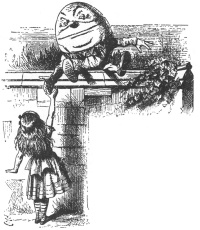
Apparently the one and only illustration he
was completely pleased with was the one of Alice and Humpty Dumpty. (Maybe because it didn't show Alice's face?)
And then, when it came time to get the
second Alice book published, Dodgson demanded a different illustrator.
Fortunately his publisher put his foot down and Tenniell’s Alice lived again.
Today, of course, the idea that Tenniell’s
illustrations aren’t exactly right is like questioning the shape of Ben Nevis.
The illustrations simply are.
But I can kind of feel a little sympathy
for Dodgson. While he was writing the book, he must have had a crystal clear
image in his mind of how Alice, and Wonderland, and all the other characters,
looked.
And when he saw Tenniell’s versions, he
must have realized that his own vision would never see the light of day. Anyone
who read the book would carry away with them Tenniell’s vision, not his own.
And who knows what Dodgson actually saw in
his own mind, and how he would have drawn it if he’d only had the talent? I’m
sure it would have been as surreal as his writing. But we’ll never know.
Subscribe to:
Posts (Atom)